

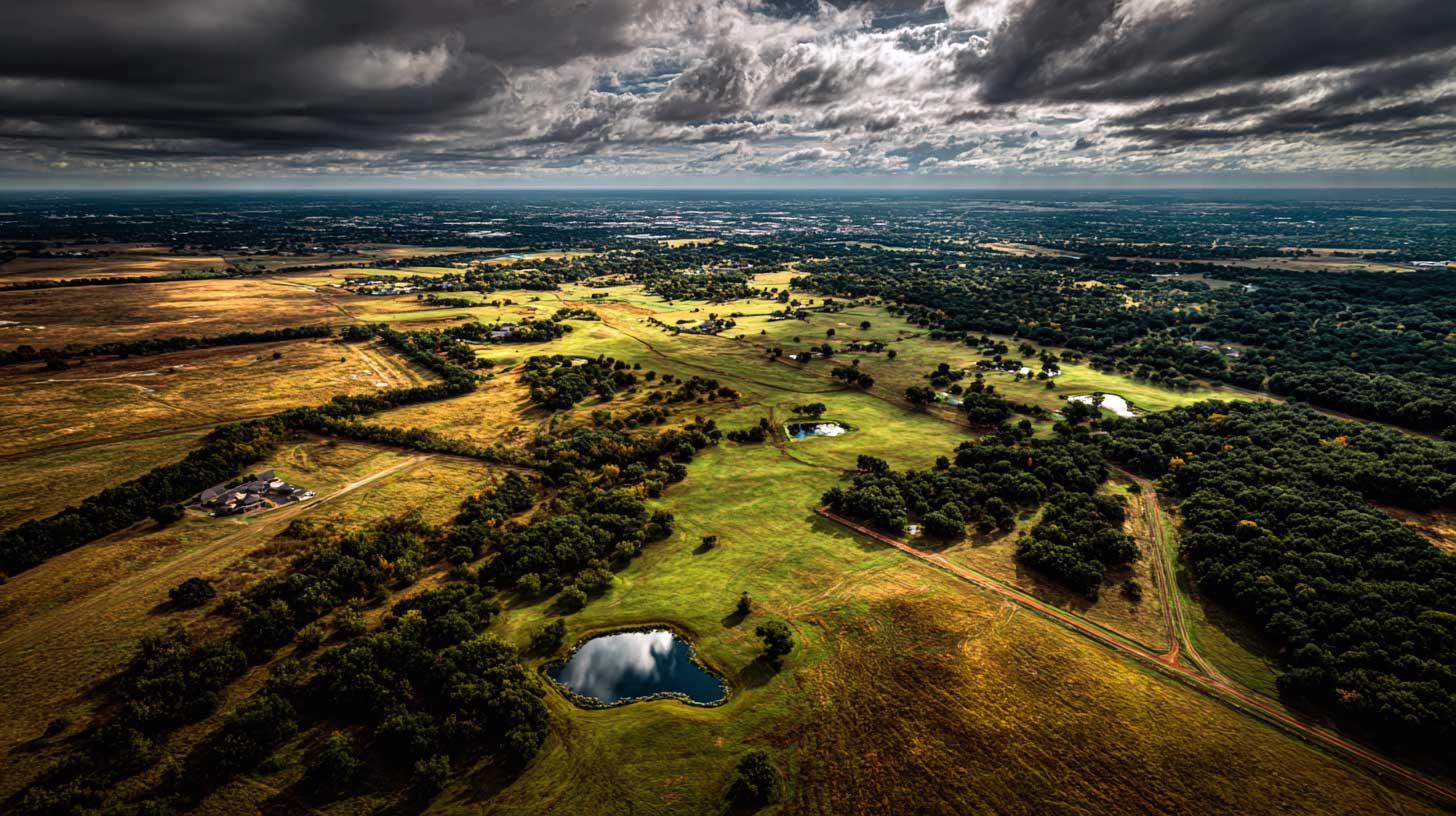
Collin County, Texas
Where North Texas Growth Meets Rural Opportunity
- Population
- 1.27 million (Jan 2025)
- County Size
- 886 square miles
- Price/Acre
- $79,000–$154,000
- Active Listings
- 850+ properties across 10,700+ acres
- Days on Market
- ~75 days
- To Dallas
- 30–50 min
Why Collin?
Collin County is no longer just a suburb of Dallas. It's become one of the most dynamic growth corridors in the country, home to 24 Fortune 500 headquarters, a population that's added nearly 200,000 residents since the 2020 Census, and a land market where demand consistently outpaces supply. For land buyers, that creates a specific kind of opportunity and a specific kind of risk. Prices have appreciated steadily, with some estimates placing year-over-year growth at 45% for Collin County land. But that appreciation isn't uniform. A 10-acre tract east of Princeton and a 10-acre tract west of Prosper are two completely different investments, even though they're in the same county. This guide breaks down what you need to know before buying land in Collin County, from zoning and water access to school districts and growth corridors.
Market Snapshot
Collin County land values vary dramatically based on location, tract size, and proximity to development. Here's what the current market looks like: Smaller residential lots (under 2 acres) near established cities like Frisco, Prosper, or McKinney can run well north of $150,000 per acre. As you move into larger rural tracts say 10 acres and above, especially in the northern and eastern parts of the county near Celina, Melissa, Anna, Blue Ridge, or Princeton, prices typically range from $25,000 to $80,000 per acre depending on road frontage, utilities, and development potential. Development-ready parcels with entitlements, approved concept plans, or existing infrastructure command premium pricing. The median listing price on Land.com sits around $79,000 per acre, while LandSearch reports an average closer to $154,000 per acre the gap reflects the mix of small infill lots and larger rural tracts.
Land Types Available
Residential Acreage (1–10 Acres) The most active segment. Buyers are typically families looking to build a custom home on acreage, often in a specific school district. Common in Celina, Melissa, Prosper, and Anna. Expect to see 1-acre minimums in many subdivisions, with unrestricted tracts of 5–10 acres available in more rural areas. Farm & Ranch Tracts (10–50+ Acres) Available primarily in the northern and eastern parts of the county Blue Ridge, Farmersville, Princeton, and unincorporated areas. Many carry ag exemptions. These are attractive to both lifestyle buyers and investors watching the growth corridor push north and east. Development Parcels Collin County's growth has created strong demand for development-ready land. Parcels with approved concept plans, completed water studies, or existing engineering are in high demand from builders. If you're evaluating a development parcel, pay close attention to which city's ETJ it falls within, as entitlement requirements vary significantly by municipality. Commercial Land Commercial parcels along the US 380 corridor, near the Dallas North Tollway extension, and along US 75 are seeing strong demand driven by the same population growth that's pushing residential values. Retail, medical, and mixed-use developments are actively seeking sites.
Zoning & Land Use
Understanding zoning in Collin County requires knowing whether a property is inside city limits, inside a city's ETJ (Extraterritorial Jurisdiction), or in unincorporated county land. The rules are different for each. Inside City Limits Full municipal zoning applies. Each city has its own zoning code, permitted uses, setbacks, lot size minimums, and building requirements. If you're buying within city limits of McKinney, Celina, Princeton, Prosper, or any other municipality, check the city's zoning map and confirm what's allowed on your specific parcel before closing. Inside a City's ETJ This is where most buyers get confused. A city's ETJ extends up to 2 miles beyond its corporate boundary (for cities with populations under 100,000; larger cities can extend further). Here's the critical distinction: cities can regulate subdivision of land in their ETJ, but they cannot enforce zoning. That means no zoning districts, no land use restrictions from the city but you do have to go through the city's platting process if you're subdividing. Building permits may be issued by the city even in the ETJ (McKinney, for example, issues building permits in its ETJ). If you're looking at unplatted land in a city's ETJ and plan to subdivide, contact both the city and Collin County Engineering to determine who has platting jurisdiction. Most cities have interlocal agreements with the county that define this. Unincorporated Collin County Land outside any city limits or ETJ falls under Collin County's subdivision regulations. The county regulates platting and road standards but does not have zoning authority. All new parcels must have frontage on a public road or existing improved private road with proper easements. If a new road is proposed, each parcel needs a minimum of 100 feet of road frontage. For subdivisions, Collin County distinguishes between "urban" lots (under 1 acre) and rural lots. If you're planning to build on land that requires on-site sewage (septic), the county's Development Services office must complete an OSSF (On-Site Sewage Facilities) suitability review. Key Takeaway Don't assume "no zoning" means "no restrictions." Deed restrictions, plat notes, ETJ subdivision regulations, and floodplain designations all apply regardless of zoning status. Always verify what you can build and what approvals are needed before you buy.
Water & Utilities
Water access is one of the most important factors in a Collin County land purchase, and it varies dramatically by location. Municipal Water Cities like McKinney, Frisco, Prosper, Celina, Anna, and Princeton provide municipal water within their city limits and sometimes within their ETJ. The North Texas Municipal Water District (NTMWD) is the regional wholesale provider that supplies water to most of these cities. If a property is within city limits or an area served by a Municipal Utility District (MUD), municipal water is typically available or can be extended. Municipal Utility Districts (MUDs) Collin County has dozens of MUDs, particularly in areas of active development around Celina, Prosper, and Princeton. MUDs are political subdivisions that fund infrastructure (water, sewer, drainage, roads) through bond issuances. If you're buying in a MUD, understand that your property tax rate will include the MUD tax, which can add $0.50–$1.50+ per $100 of assessed value on top of other taxing entities. Some of the active MUDs in Collin County include Collin County MUD No. 1 (Light Farms area near Celina), North Collin Special Utility District (Melissa area), and numerous others associated with specific developments. Well Water In more rural areas, particularly east of US 75 near Blue Ridge, Farmersville, and parts of Princeton, well water may be the primary option. The Trinity Aquifer underlies much of Collin County and provides adequate supply for residential wells in most areas. However, well depth, water quality, and flow rates vary by location. Always get a well inspection or drill test before closing on land where well water is the planned source. Septic vs. Sewer If you're outside a city's sewer service area, you'll need an on-site sewage facility (septic system). Collin County Development Services handles OSSF permitting and requires a site evaluation to determine soil suitability before a permit is issued. Not all soils support conventional septic systems and some properties may require engineered aerobic systems, which are more expensive to install and maintain. Electric Service Collin County is served by several electric providers. In more rural areas, you may be served by a cooperative like CoServ Electric (common in western Collin County near Celina and Prosper) or Grayson-Collin Electric Cooperative (northeastern areas). Within city limits, Oncor is typically the transmission and distribution provider with your choice of retail electric providers. Internet & Broadband This matters more than people expect, especially for remote workers. Urban and suburban areas have robust broadband through providers like AT&T Fiber and Spectrum. Rural areas can be more limited. Starlink has become a viable option for rural tracts, but verify coverage and speeds for your specific location before assuming you'll have adequate connectivity.
Ag Exemptions & Property Taxes
Property Tax Rates Collin County's base county tax rate is approximately $0.149 per $100 of assessed value (2025). However, your total property tax bill includes multiple taxing entities:county, city (if applicable), school district, MUD (if applicable), and any special districts. Total effective rates typically range from 1.5% to 2.5% of assessed value depending on your location and which taxing entities apply. The average home value in Collin County is approximately $600,000, with a 2.9% increase from the prior year. Median household income is $117,588 but housing affordability for first-time buyers is worse in Collin County than in Dallas or Denton counties. Agricultural (1-d-1) Exemptions Ag exemptions are critical for land buyers in Collin County because they can dramatically reduce your property tax burden. An ag exemption doesn't exempt you from taxes, it changes the basis of your assessment from market value to agricultural productivity value, which is substantially lower. Common qualifying uses in Collin County: Cattle grazing - The most common ag use in the county. Generally requires a minimum stocking rate and active management. Hay production - Cutting and baling hay on the property. Must demonstrate commercial production, not just mowing. Horse operations -Can qualify if horses are used for breeding or as part of an agricultural operation (not solely recreational). Crop production - Row crops, though less common than grazing or hay in Collin County. Wildlife management - Available as a conversion from an existing ag exemption. Requires a wildlife management plan with specific activities (habitat control, erosion control, predator management, providing supplemental water, providing supplemental food, providing supplemental shelter, or census counts). Key requirements: The land must have been in agricultural use for 5 of the preceding 7 years (for 1-d-1 open-space valuation). There is no statutory minimum acreage, but the Collin Central Appraisal District evaluates whether the operation is legitimate and commercially viable. In practice, very small tracts (under 5 acres) face more scrutiny. If you purchase land with an existing ag exemption and change the use, you'll owe rollback taxes for the previous 5 years — the difference between what you paid under ag valuation and what you would have paid at market value, plus 7% annual interest. Appraisal District Contact: Collin Central Appraisal District (CCAD) 250 W. Eldorado Pkwy, McKinney, TX 75069 collincad.org
Growth & Development
Understanding where Collin County is heading matters as much as understanding where it is today. Three major infrastructure projects are reshaping the county's geography. US 380 Expansion US 380 is the primary east-west corridor across Collin County, connecting Prosper, Frisco, McKinney, and Princeton. TxDOT is expanding the highway from a two-to-four lane state highway into an eight-to-ten lane freeway in multiple segments. In the Princeton area, a new-location bypass will route the freeway north around the city. This is a multi-year, multi-billion-dollar project that will fundamentally change accessibility and land values along the corridor. The expansion has been separated into five independent segments, each advancing on different schedules depending on traffic needs and funding. Right-of-way acquisition began in early 2025 for the Princeton segment, with construction anticipated to let in 2027. Collin County Outer Loop The Outer Loop is a planned 53-mile transportation facility connecting major highways including I-35, US 377, the Dallas North Tollway extension, SH 289, US 75, SH 121, US 380, and I-30. In November 2025, the county opened a new 15-mile segment connecting the Dallas North Tollway in Celina with US 75 north of Melissa. This was a $62.7 million project built entirely with local bond money, no state or federal dollars, and completed ahead of schedule. Additional segments are planned to connect US 380 in Farmersville to FM 6 in Josephine and SH 121. The Outer Loop is designed with future expansion in mind, including additional lanes. A new Collin County Northeast Freeway study is also underway, looking at a proposed 10-mile freeway from SH 121 to the future US 380 Freeway. For land buyers, the Outer Loop is a leading indicator of where development will follow. Properties along or near the planned route, especially at future interchange locations are positioned for significant value appreciation. Dallas North Tollway Extension The northward extension of the Dallas North Tollway continues to push through Prosper and into Celina, bringing with it major commercial development, master-planned communities, and rising land values. If you're looking at land west of US 75 and north of Prosper, the tollway extension is the single biggest factor influencing values. What This Means for Buyers The growth corridors are moving north and east. Celina, Melissa, Anna, and Princeton are the current frontier of development. Land prices in these areas have already begun to reflect that reality, but there's still a meaningful spread between land values in established areas and land in the path of growth. The infrastructure investments underway will compress that spread over the next 5–10 years.
Schools & Community
Collin County is served by multiple school districts, many of which are among the highest-rated in Texas. School district boundaries don't follow city lines, so a property in Celina might be in Prosper ISD, and a property near Princeton might be in Melissa ISD. Always verify the specific school district for any property you're evaluating. Top-Rated Districts Lovejoy ISD - Consistently rated among the best in the state. Covers Fairview, Lucas, and surrounding areas. Small district (~4,100 students) with strong academic performance. Prosper ISD - One of the fastest-growing districts in Texas, now serving 32,000+ students with 4 high schools and 6 middle schools. Ranked #1 in Collin County for athletes and #2 for teaching. Covers parts of Prosper, Celina, Frisco, and McKinney. Frisco ISD - Large district (~66,000 students) spanning Collin and Denton counties. Well-funded with modern facilities and strong academic programs. Allen ISD - Single high school district (Allen High School is one of the largest in the state) with strong athletics and academics. McKinney ISD - Serves ~23,300 students. Established district with a mix of newer and legacy campuses. Plano ISD - One of the largest districts in the state (~48,000 students). Mature district with strong AP and IB programs. Growing Districts to Watch Celina ISD - Rapidly growing (~4,400 students) with new campuses under construction to keep pace with population growth. Melissa ISD - Serving ~6,500 students. Growing quickly with the expansion of Melissa and surrounding areas. Princeton ISD - One of the fastest-growing districts in the state (~8,700 students), mirroring the city's explosive population growth. Anna ISD - Growing alongside the city of Anna's expansion northward. Why School District Matters for Land Buyers Even if you don't have school-age children, the school district attached to your property directly impacts resale value. Properties in Prosper ISD and Lovejoy ISD command premium prices over comparable properties in other districts. For investors and developers, school district is one of the first filters buyers apply when searching for land.
Due Diligence Checklist
Before closing on any land purchase in Collin County, verify the following: 1. Jurisdiction & Zoning Is the property inside city limits, in a city's ETJ, or in unincorporated county land? If in an ETJ, which city? What are their subdivision and building permit requirements? Are there any deed restrictions, plat notes, or HOA covenants? If unincorporated, review Collin County Subdivision Regulations. 2. Water & Utilities Is municipal water available, or will you need a well? Is city sewer available, or will you need a septic system? Has a soil study been done for septic suitability? Which electric provider serves the area? What internet/broadband options are available? 3. Flood & Drainage Is any portion of the property in a FEMA-designated floodplain? If developing 5+ acres or 50+ lots, a flood study may be required. Check FEMA flood maps at fema.gov/flood-maps. 4. Survey & Access Do you have a current survey? If not, get one. Does the property have legal access via a public road? Is there adequate road frontage (minimum 100 feet required for subdivisions)? Are there any easements (utility, pipeline, access) crossing the property? 5. Agricultural Exemption Does the property currently carry an ag exemption? If so, what use qualifies it? Will you continue that use? If you change the use, calculate the rollback tax liability before closing. 6. Environmental & Title Are mineral rights included or reserved? Are there any environmental concerns (previous commercial use, underground storage tanks)? Get title insurance and review the title commitment carefully. 7. Financial Land loans typically require 20–30% down with 15–20 year terms. Construction-to-permanent loans can roll land purchase and building into one loan. Some sellers offer owner financing with more flexible terms. Texas Farm Credit and local community banks are common lenders for land transactions.
Available Land in Collin County
Browse our current listings in Collin County. We'll help you find the perfect property.
Browse ListingsReady to Buy Land in Collin County?
Our team has deep expertise in Collin County properties. Let us help you find your perfect piece of land.
Contact Our Team