

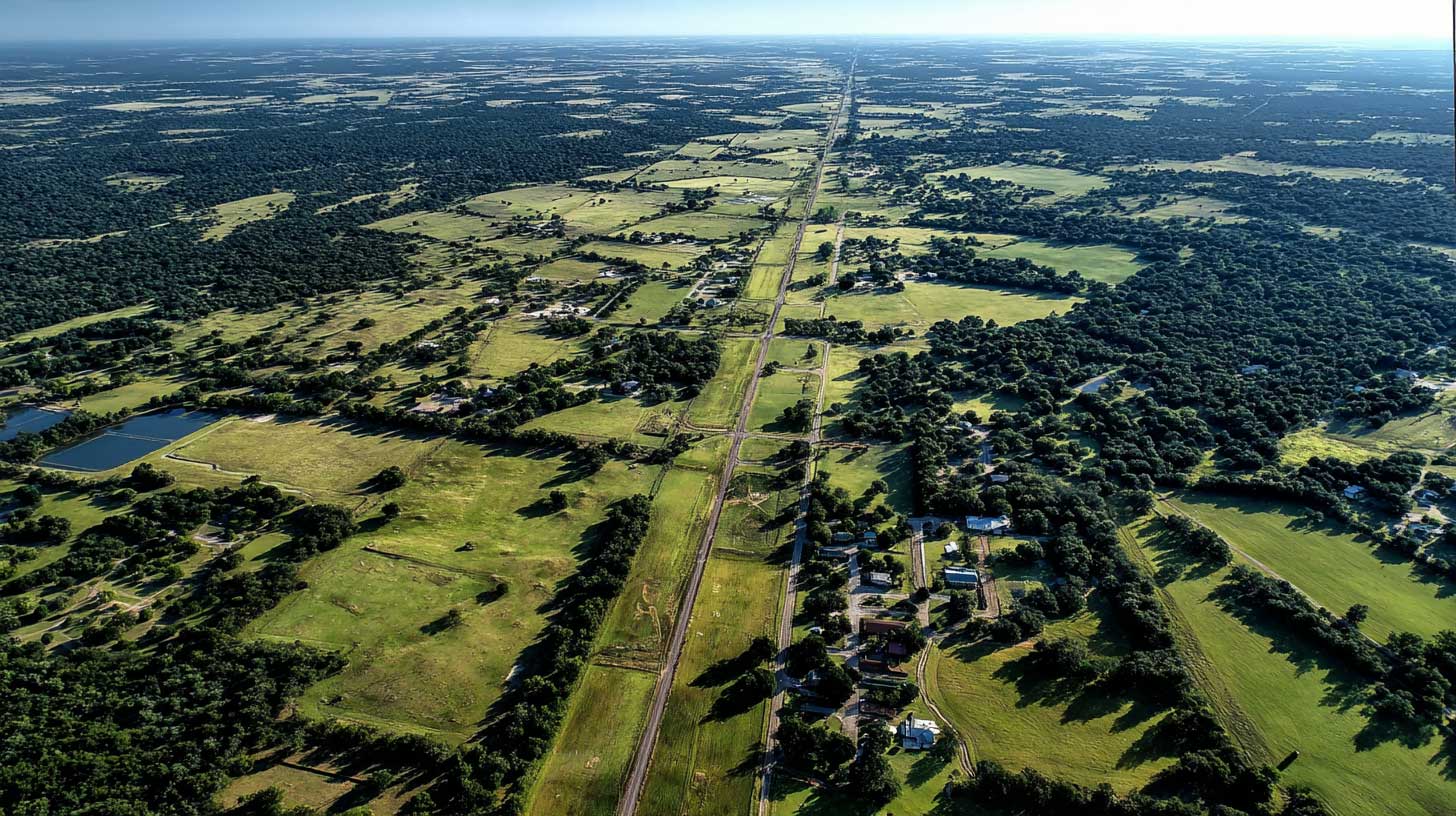
Denton County, Texas
The Last County Inside DFW Where You Can Still Find Acreage
- Population
- ~1.07 million (2026 est.), one of the fastest-growing counties in the U.S.
- County Size
- 952 square miles
- Price/Acre
- $106,000–$165,000 (varies significantly by location and tract size)
- Active Listings
- 800+ properties across ~9,000+ acres
- Avg. Listing Price
- $1,874,283
- Days on Market
- ~78 days
- To Dallas
- 30–50 minutes
- County Seat
- Denton
Why Denton?
Denton County is a different calculation than every other county in your search. You are not looking at a future growth story here — you are looking at a market that is already one of the top five fastest-growing counties in the United States. The question for buyers is not whether Denton County will appreciate. It already has, dramatically. The question is whether you can find a piece of it before the remaining rural acreage is consumed by the subdivisions marching steadily northward from Frisco, Flower Mound, and Lewisville.
What that means practically: Denton County land trades at a significant premium over neighboring counties. Median price per acre runs $106,000–$165,000 depending on location and source data — roughly 6 to 8 times the price per acre you will find in Grayson County, and 4 to 6 times Fannin County pricing. But the buyer pool is also dramatically larger, the absorption rate is among the fastest in Texas (properties averaging 78 days on market), and the underlying demand drivers — population growth, job creation, proximity to DFW — are not slowing down.
The rural acreage that remains in Denton County is concentrated in three areas: the northern tier near Sanger, Pilot Point, and Aubrey; the western corridor around Ponder, Justin, and Rhome; and isolated pockets inside the ETJs of cities that have not yet annexed adjacent farmland. These windows are closing. The same development pattern that consumed Frisco and Prosper in Collin County is now moving through Celina, Anna, and Gunter — and Denton County's growth pressure is approaching from the other direction.
For buyers, that creates urgency. For sellers, it creates one of the strongest negotiating positions in North Texas.
Market Snapshot
Denton County's land market is divided by geography and development pressure. The southern half — Lewisville, Flower Mound, Argyle, and Bartonville — is functionally urban, with land values reflecting dense suburban development. The northern half, from Denton city through Sanger, Pilot Point, Ponder, and Aubrey, retains meaningful rural acreage but is actively being absorbed.
Price Ranges by Location and Use
In south Denton County near Flower Mound, Argyle, and Bartonville, estate-sized lots and development-positioned tracts trade at $150,000–$250,000+ per acre. These areas are some of the most expensive suburban acreage in North Texas and attract a buyer profile that prioritizes school district quality and proximity to employment over acreage volume.
The Denton city corridor along US 380 and I-35 represents a mix of development-positioned commercial tracts and rural residential land. Pricing ranges from $80,000–$140,000 per acre depending on utility access and proximity to the US 380 growth corridor.
North of Denton city toward Sanger, Pilot Point, and Aubrey, more traditional acreage is available in the $50,000–$110,000 per acre range. These are the areas with the most active land transactions and the widest buyer pool — from lifestyle ranch buyers to developers watching the Celina growth corridor extend northward.
Western Denton County around Ponder and Justin offers the best value per acre in the county, typically $40,000–$80,000 per acre, with genuine agricultural character and 45-minute access to Fort Worth.
Demand Indicators
Denton County's absorption rate of 270% is the second-highest in Texas — properties sell faster than new listings appear on an annualized basis. Days on market average 78, which is fast for acreage transactions that typically require more due diligence than residential sales. Well-priced, well-located land simply does not sit.
Land Types Available
Development-Positioned Tracts (South and Central Denton County)
The most competitively priced segment. Small-to-mid acreage (2–30 acres) along the US 380 corridor and the I-35 corridor is actively being assembled for residential subdivision. ETJ proximity, utility availability, and school district alignment are the primary value drivers. These properties trade quickly when priced correctly.
Equestrian and Horse Properties (Pilot Point Corridor)
Pilot Point and the surrounding area is one of the most established equestrian communities in North Texas. Horse facilities, training operations, and equestrian estates are concentrated here, supported by a network of buyers who understand and specifically seek this submarket. Properties with barns, arenas, cross-fencing, and horse-appropriate pasture command significant premiums.
Ranch and Agricultural Land (Northern and Western County)
Working cattle operations, hay production tracts, and mixed-use ag properties are concentrated north of the city of Denton toward Sanger and west toward Ponder. These are the properties with the most acreage available and the most traditional land buyer profile. Native grass, improved pasture, and post oak cover characterize much of the landscape.
Rural Residential Homesites
5–20 acre tracts outside city limits throughout the northern and western county appeal to buyers wanting space, livestock capability, and rural character while remaining within commuting distance of DFW employment. Many carry existing ag exemptions and offer a genuine lifestyle play.
Waterfront and Lake-Adjacent Properties
Lake Lewisville in the southern county and Lake Ray Roberts on the Denton/Cooke County line create distinct waterfront submarkets. Lake-adjacent tracts carry their own buyer demographic and pricing logic separate from agricultural land values.
Zoning & Land Use
Unincorporated Denton County
Like most Texas counties, Denton County has no county-wide zoning authority outside of city limits and ETJs. Land in unincorporated areas can generally be used for residential, agricultural, or commercial purposes without zoning approval — a significant advantage for buyers who want flexibility.
However, Denton County is more developed than most rural counties, and the patchwork of ETJs from numerous growing cities creates complexity. Properties that appear rural may fall within the ETJ of Denton, Frisco, Celina, Aubrey, or another expanding city — each of which carries subdivision authority and development restrictions even before annexation.
City Jurisdictions
The City of Denton is the most significant regulatory presence. Denton's ETJ is substantial and the city actively enforces subdivision standards, road design requirements, and utility provisions within it. Buyers planning to subdivide or develop inside Denton's ETJ should review the city's Subdivision Regulations and engage with the planning department early.
Aubrey, Celina, and Sanger are each growing rapidly and updating their development regulations to manage growth. Argyle and Bartonville have specific ordinances governing residential development standards and building materials — particularly relevant for buyers considering construction in those communities.
Subdivision Rules
In unincorporated Denton County, tracts of 10 acres or larger can generally be sold without county platting approval provided they have road frontage. Dividing property into tracts under 10 acres triggers county subdivision platting requirements. Given the density of ETJs in Denton County, always verify whether the subject property falls inside a city's ETJ before assuming unincorporated county rules apply.
Water & Utilities
Water
Water availability in Denton County varies significantly by location. The eastern and southern portions of the county have access to Metroplex-extended municipal water systems — a key factor in those areas' development appeal. The northern and western portions rely more heavily on wells and rural water supply districts.
Lake Lewisville (serving as a major DFW water supply reservoir) and Lake Ray Roberts are the primary surface water assets. The Denton Municipal Utilities district serves the city and portions of the ETJ. North Texas Municipal Water District and Upper Trinity Regional Water District serve portions of the eastern county.
Rural buyers in northern and western Denton County should verify well capacity and water quality as part of due diligence. The Barnett Shale era of natural gas production has created localized groundwater quality concerns in portions of the county — well testing is not optional.
Electricity
Oncor serves most of Denton County. CoServ Electric serves portions of the eastern county near the Collin County line. Rural line extensions can be required for new construction — get cost estimates from the provider early, especially for properties requiring significant service runs.
Internet and Communications
Fiber broadband is available in most incorporated areas and some suburban unincorporated areas. Rural northern and western Denton County has variable coverage. Nextlink, Starlink, and fixed wireless providers fill gaps where fiber has not extended. The growth of remote work has increased buyer demand for verified broadband access on rural properties.
Roads and Transportation
I-35 (both the E and W splits through the county), US 380, US 377, and FM 156 are the primary road corridors. Denton County has an active FM road system that provides access to most rural areas. DCTA (Denton County Transportation Authority) provides commuter rail service from Denton to the Trinity Railway Express in Carrollton, offering a transit option for buyers in the southern county.
Infrastructure Watch
The US 380 widening project is the most significant infrastructure investment affecting land values in central Denton County. As this corridor improves, land along and near it will see continued appreciation. The extension of utilities from southern Denton County northward is the primary variable affecting the pace of development in the Aubrey, Pilot Point, and Sanger areas.
Ag Exemptions & Property Taxes
Agricultural exemptions are available throughout Denton County but face increasing scrutiny in areas with high development pressure. The Denton Central Appraisal District (DCAD) is one of the more active appraisal districts in the state when it comes to challenging exemptions as surrounding development pressure increases.
Qualifying Activities
Cattle grazing is the most common qualifying use. The general stocking guideline for Denton County is approximately 1 animal unit per 10–20 acres depending on pasture quality, though specific rates should be verified with the DCAD. Hay production, horse breeding (with commercial intent), exotic wildlife operations, beekeeping, and wildlife management plans also qualify.
Minimum Acreage and Scrutiny Level
There is no statutory minimum acreage for ag exemptions in Texas, but the DCAD evaluates whether land is being used for genuine agricultural production at a scale consistent with the area and use type. In high-growth areas of southern and central Denton County, tracts under 20 acres face significant scrutiny. In the northern and western agricultural areas, exemptions are more straightforward to maintain.
Wildlife Management Exemptions
Wildlife management valuation is popular in Denton County, particularly on smaller recreational tracts where traditional livestock operations are impractical. The property must have had an active ag exemption in place, typically for at least one year prior. Qualifying activities include habitat management, supplemental food and water, shelter management, predator management, and annual census documentation.
Rollback Taxes
If a property with an active ag exemption is purchased and converted to non-agricultural use — including residential development — rollback taxes apply for the prior five years. The rollback equals the difference between taxes paid under ag valuation and what taxes would have been at full market value, plus 7% annual interest. On a 50-acre development tract in south Denton County, rollback exposure can reach $100,000–$300,000+. This must be factored into any development pro forma.
Growth & Development
Denton County's growth story is not speculative — it is actively happening and has been for two decades. The relevant question for buyers is not whether it will continue but where the next wave of development pressure is building.
Southern Denton County: Already Transformed
The communities along the Tarrant County line — Lewisville, Flower Mound, Grapevine, Coppell — are effectively urban. The development story here is infill and redevelopment, not raw acreage transactions. Land values in this area reflect suburban infill economics.
Central Corridor: Active Transformation
The Denton/Argyle/Northlake corridor along I-35W is in active suburban buildout. Significant residential developments are ongoing, and commercial development is following population. Argyle ISD, one of the fastest-growing school districts in the state, is expanding facilities to accommodate growth. Land prices here are high and rising.
Northern Tier: The Current Opportunity
Aubrey, Celina's northward growth path, and the Sanger corridor represent the current leading edge of affordable acreage within Denton County. Buyers who understand the pattern — watching where infrastructure commitments (water, roads, schools) are being made — are positioning here before development fully arrives.
Western County: Value with Different Drivers
Ponder, Justin, and Rhome sit at the intersection of Denton and Wise counties. Growth pressure here comes from Fort Worth's northward and westward expansion, not the Frisco/Collin County growth machine. This is a distinct buyer and investment profile — more agricultural character, better value per acre, longer development timeline.
Schools & Community
School Districts
Denton County is served by numerous school districts, and district quality is a primary driver of land values in many parts of the county:
Argyle ISD: Consistently ranked among the top districts in Texas. Small size with exceptional academic and athletic programs. Land within Argyle ISD boundaries commands a significant premium.
Northwest ISD (Justin/Northlake): One of the fastest-growing districts in the state. Serves a large geographic area in western Denton County with modern facilities and strong programming.
Denton ISD: The county's largest district serving the city of Denton and surrounding areas. Strong university-town academic culture supported by the presence of UNT and TWU.
Aubrey ISD: Growing rapidly as the Aubrey area absorbs development spillover from Celina. New school construction underway.
Pilot Point ISD: Small district with strong community identity serving the equestrian and rural residential community around Pilot Point.
Sanger ISD: Serves Sanger and northern Denton County rural areas. Growing as the I-35 corridor extends northward.
Ponder ISD: Small rural district serving western Denton County with a strong community character.
Healthcare
Texas Health Presbyterian Hospital Denton and Medical City Denton serve the county's healthcare needs. The University of North Texas Health Science Center in Fort Worth (30 minutes) provides specialized care access. For south county residents, a full range of Metroplex hospital systems are within 30–45 minutes.
Character and Community
Denton County contains multitudes. The city of Denton has a distinct university-town identity shaped by UNT (41,000 students) and TWU (16,000 students) — creative, independent, and authentically Texan. The southern communities are suburban in character. The northern and western communities retain genuine rural Texas identity — working ranches, county fairs, rodeos, and deep agricultural roots. New residents arriving from the Metroplex are gradually reshaping community character in many areas, but the county's rural heritage remains visible and valued by longtime residents.
Due Diligence Checklist
Before purchasing land in Denton County, investigate these critical factors:
Utility availability and cost. In Denton County, the presence or absence of city water/sewer can affect per-acre value by $20,000–$50,000+. Verify who provides service, confirm connection availability (not just proximity to a line), and get cost estimates for new service if required. For rural properties, test well water quality and yield — particularly in areas with historical oil and gas activity.
ETJ status and applicable regulations. Determine whether the property falls within any city's Extraterritorial Jurisdiction. In Denton County, ETJ boundaries can reach 5 miles outside city limits and carry subdivision authority. Know whose ETJ you're in, what their development regulations require, and what the city's annexation plans are.
Floodplain and drainage. Denton County has significant floodplain areas, particularly near Lake Lewisville, Lake Ray Roberts, and the creek systems feeding them. Obtain a current FEMA flood map analysis and verify whether any portion of the target property falls in a Special Flood Hazard Area. Flood insurance requirements can materially affect the economics of a purchase.
Ag exemption and rollback exposure. Verify the current agricultural exemption status with the DCAD. If the property has an existing exemption and you plan to develop or change use, calculate rollback tax exposure before closing. On high-value Denton County tracts, this can be a six-figure liability.
Mineral rights. Denton County sits over the Barnett Shale formation. Mineral rights are frequently severed from surface rights throughout the county. Verify whether minerals convey, and investigate any existing surface use agreements, pipeline easements, or active wells that may affect use of the property.
Survey. Get a current survey. Property lines in rural Denton County may not match fence lines, and utility easements, pipeline rights-of-way, and access easements may not be visible on a physical inspection. A current boundary and easement survey is non-negotiable.
School district verification. Confirm the property's school district assignment directly with the applicable ISDs before closing — particularly relevant in border areas between districts. School district is a primary driver of value and may affect financing.
Frequently Asked Questions About Denton County
How much does land cost in Denton County Texas?
Is Denton County land a good investment?
What is the fastest-growing area in Denton County?
Are ag exemptions available in Denton County?
What school districts are in Denton County?
How far is Denton County from Dallas?
Can I build a barndominium in Denton County?
What about mineral rights in Denton County?
Ready to Buy Land in Denton County?
Our team has deep expertise in Denton County properties. Let us help you find your perfect piece of land.
Contact Our Team