

Fannin County, Texas
Two New Lakes, One County, and the Last Affordable Acreage This Close to DFW
- Population
- ~40,200 (2026 est.), growing at 2.0% annually
- County Size
- 899 square miles
- Price/Acre
- $8,000–$27,000 (varies by location and tract size)
- Active Listings
- 530+ properties across 14,000+ acres
- Avg. Listing Price
- $720,500
- To Dallas
- 75–90 minutes via US 75/SH 121
- County Seat
- Bonham
Why Fannin?
Fannin County is the quietest transformation story in North Texas. While everyone watches Collin County's subdivision boom and Grayson County's semiconductor headlines, Fannin County just became the only county in Texas — maybe the country — to get two brand-new reservoirs within five years.
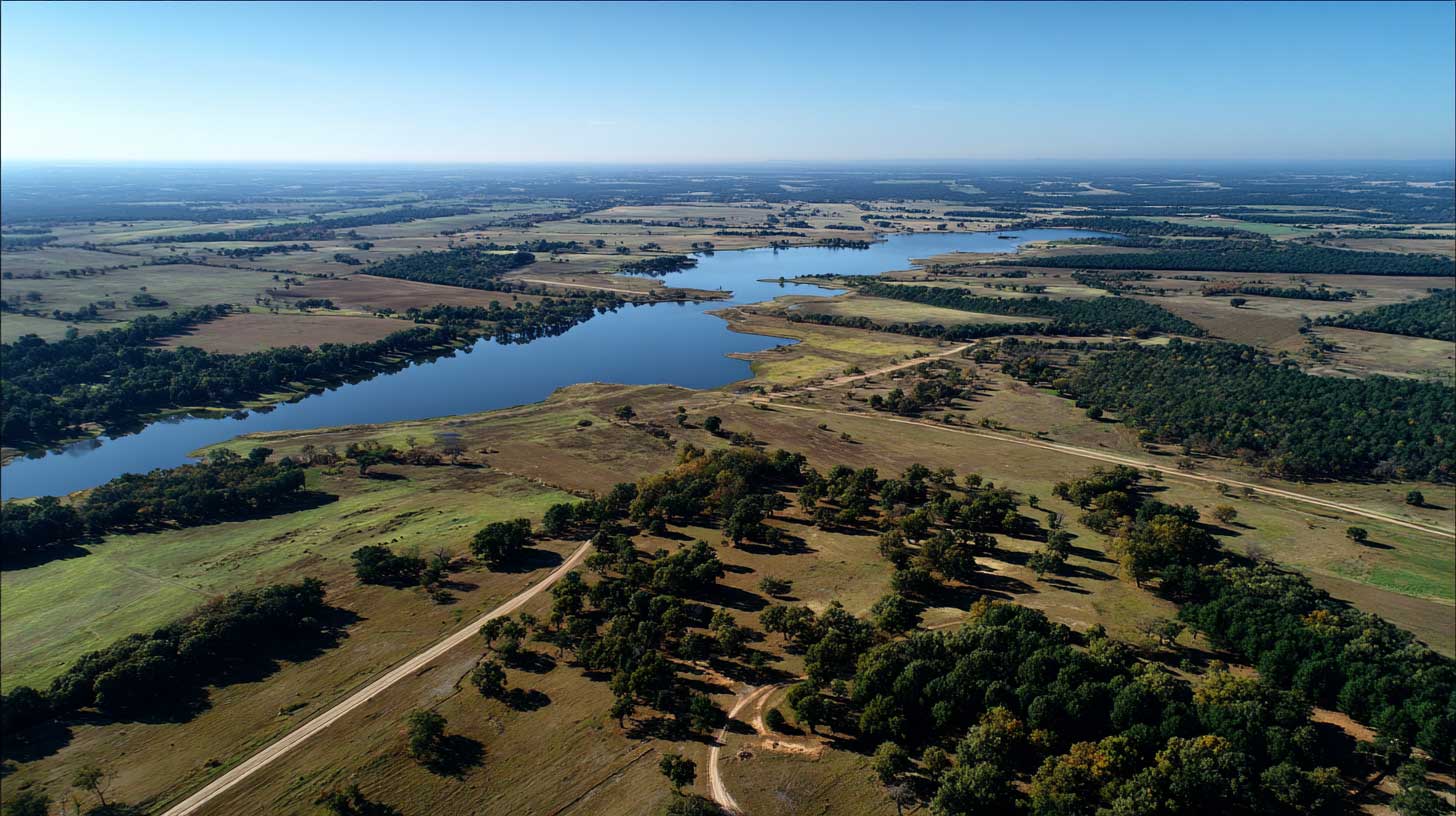
Bois d'Arc Lake, completed in 2022, was the first major reservoir built in Texas in over 30 years. It covers 16,641 acres (26 square miles), supplies up to 82 million gallons of water per day, and is already open for fishing and boating. Lake Ralph Hall, under construction on the North Sulphur River near Ladonia, will add another 7,600 acres of reservoir surface and deliver up to 54 million gallons per day when it completes in 2026.
Together, these two lakes represent roughly $2 billion in infrastructure investment in a county of 40,000 people. That's not a rounding error. That's a fundamental reshaping of a county's economic future.
For land buyers, the math is straightforward. Fannin County offers the lowest price per acre of any county within 90 minutes of Dallas. It now has two major recreational lakes (plus Bonham State Park and nearby Lake Texoma access). It sits directly east of Grayson County, which is experiencing semiconductor-driven growth, and directly north of Collin County, which has been the fastest-growing county in Texas for a decade. And it still has real agricultural land — working ranches, hay fields, cattle operations — available at prices that Collin County hasn't seen in 15 years.
The catch? Fannin County is genuinely rural. There's no US 75 running through it. The infrastructure is thinner. The towns are smaller. The pace of development will be slower than in Grayson or Denton counties. But for buyers who want acreage, elbow room, lake access, and a realistic path to appreciation without paying DFW-adjacent prices, Fannin County is the value play in the region right now.
Market Snapshot
Fannin County's land market is dominated by agricultural and recreational tracts. The average listing price across all land types is approximately $720,500, with an average of $27,029 per acre according to LandSearch. But those averages are skewed by larger improved properties.
Price Ranges by Location and Use
The western side of the county — closer to Grayson County and the US 75 corridor — commands higher prices. The Trenton area, which borders Collin and Grayson counties, is seeing spillover pricing from suburban growth. Small residential tracts in the Trenton ISD area can approach $20,000–$30,000+ per acre.
Around Bonham, the county seat, prices are moderate. Bonham has the most services, retail, and medical infrastructure in the county, and its proximity to both Bois d'Arc Lake and Bonham State Park makes it the natural hub. Improved farm and ranch tracts within 10 miles of Bonham typically range from $8,000–$18,000 per acre depending on size and improvements.
Near Bois d'Arc Lake, prices are adjusting upward as recreational demand increases. The lake attracted nearly 17,000 anglers from Texas and eight other states in its first six months of public access. Anglers caught approximately 98,000 bass, crappie, and catfish from April to June 2024 alone. Tracts with lake proximity or views command premiums over comparable inland acreage.
Near Ladonia and the future Lake Ralph Hall in the southeastern part of the county, speculative buying has been active. People have been lining up to purchase adjacent property. Once the lake fills (dependent on rainfall, potentially 3–5 years) and recreational access opens, prices in that area will likely follow the Bois d'Arc Lake pattern.
The eastern and northern parts of the county — Honey Grove, Windom, Ravenna — remain the most affordable. Large agricultural tracts in these areas can still be found in the $5,000–$12,000 per acre range, making them among the lowest-cost options within a reasonable drive of DFW.
Land.com reports an average lot size of 73 acres in Fannin County listings, with a total of approximately 100,000 acres of rural land listed across the county — ranking Fannin 29th among Texas' 254 counties for total acreage on the market.
Land Types Available
Farm & Ranch Tracts (10–200+ Acres)
This is the primary market in Fannin County. Rolling terrain with a mix of improved pasture, native grass, and scattered hardwoods. Soil types range from blackland clay in the southern portions to sandy loam in the north. Cattle, hay, wheat, and horse operations dominate. Many properties have existing fencing, stock ponds, and working improvements. Larger tracts (100+ acres) with established ag operations are available here at prices that would be unthinkable in Collin or Denton counties.
Residential Acreage (1–10 Acres)
Growing primarily around Bonham, Trenton, and areas near Bois d'Arc Lake. Buyers are typically DFW commuters willing to trade drive time for space and price, retirees relocating to lake-adjacent living, or remote workers who no longer need daily access to the Metroplex. The Trenton area attracts buyers from the Collin County overflow who want small-town living with decent school access.
Lake-Proximity Tracts
A category that barely existed in Fannin County five years ago. Bois d'Arc Lake's 16,641 acres of surface water and Lake Ralph Hall's forthcoming 7,600 acres have created an entirely new land market segment. Tracts within a few miles of either lake are attracting recreational buyers, weekend-home builders, and investors. Waterfront or near-waterfront parcels are the most competitive.
Hunting & Recreational Land
Fannin County's mix of timber, creek bottoms, open pasture, and agricultural fields creates excellent habitat for whitetail deer, turkey, hog, and waterfowl. The Riverby Ranch environmental mitigation project near Bois d'Arc Lake includes planting of 6 million new trees and restoration of thousands of acres of wetlands and grasslands, which is expanding wildlife habitat significantly. Hunting leases generate income on properties throughout the county.
Development Parcels
Limited but emerging. Bonham and the areas around both lakes are seeing increased interest from developers. Fannin County worked with NTMWD to develop a comprehensive plan for development around Bois d'Arc Lake, including zoning and development guidance. This proactive planning is unusual for a rural county and signals that the infrastructure for managed growth is being put in place.
Zoning & Land Use
Unincorporated Fannin County
Like most Texas counties, Fannin County does not have broad zoning authority. However, the county has taken a notably proactive approach to land use planning around Bois d'Arc Lake. Working with NTMWD, the county developed a comprehensive plan that includes zoning and development guidance for the lake area. This is significant — it means certain areas near Bois d'Arc Lake may have development standards that don't apply elsewhere in unincorporated Fannin County.
City Jurisdictions
Bonham is the largest city and has its own zoning, permitting, and ETJ regulations. Leonard, Trenton, Honey Grove, Ladonia, Savoy, Ector, Dodd City, and other smaller municipalities have varying levels of zoning and land use regulation. In general, once you're outside city limits and ETJs in Fannin County, land use is largely unrestricted beyond county subdivision regulations.
Bois d'Arc Lake Shoreline Management
NTMWD has established a Shoreline Management Plan for Bois d'Arc Lake that classifies shoreline areas and regulates docks, structures, and land use near the water. If you're buying near the lake, understand that this plan may restrict what you can build or how you can access the water from your property. Authorization is required for docks and other shoreline uses.
Lake Ralph Hall Development
As Lake Ralph Hall approaches completion, similar shoreline management and development standards will likely be implemented. Buyers purchasing near the future lake should anticipate regulations and factor them into their plans.
Water & Utilities
The Two-Lake Advantage
Fannin County's water situation has been fundamentally transformed. Bois d'Arc Lake, owned by North Texas Municipal Water District (NTMWD), delivers water to the Leonard Water Treatment Plant, which began operating in March 2023 and can treat up to 70 million gallons per day (expandable to 280 MGD). NTMWD also built a new water treatment plant in Bonham. Lake Ralph Hall, owned by Upper Trinity Regional Water District, will deliver up to 54 million gallons per day through a 32-mile pipeline to communities in Denton and Collin counties, with a portion allocated to Fannin County communities.
Together these two reservoirs produce more treated water capacity than most Texas counties dream of. This is a long-term strategic advantage for the county.
Municipal Water
Bonham and Leonard have municipal water systems supplemented by NTMWD infrastructure. Other cities have smaller systems. NTMWD has committed to providing drinking water from its Fannin County treatment plants to meet local needs.
Well Water
Much of rural Fannin County still relies on well water. The Trinity Aquifer and alluvial aquifers along the river systems provide groundwater. Well depth, yield, and quality vary. The sandy loam soils in northern areas generally have better well-water conditions than the clay soils in the south. Always get a well inspection or test drill before purchasing rural land.
Septic
On-site sewage facilities are the norm outside city sewer service. Soil conditions for septic vary — the blackland clay areas can require aerobic systems rather than conventional septic. Verify soil suitability before committing to a building plan.
Electric Service
Fannin County Electric Cooperative serves most of the rural county. Oncor serves some areas within and near city limits.
Communications
This is an honest limitation. Fannin County has had significant gaps in cellular and radio coverage. NTMWD helped fund a communications tower near Bois d'Arc Lake to improve first-responder radio coverage, but rural broadband and cell service remain inconsistent in parts of the county. Starlink is popular among rural residents. If reliable high-speed internet is essential for your work, verify service at the specific property before buying.
Ag Exemptions & Property Taxes
Property Taxes
Fannin County's property tax rates are among the most competitive in the North Texas region. The median household income is $68,377, and the county's rural character keeps overall tax burdens lower than suburban counties. School district tax rates vary across the county's 12+ ISDs.
Agricultural Exemptions
Ag exemptions are deeply embedded in Fannin County's culture and economy. The county has thousands of active farms and ranches. Common qualifying uses include:
Beef cattle — The dominant ag use. Cow-calf operations and stocker programs operate throughout the county.
Hay production — Improved coastal bermuda and native grass hay are widely grown. Fannin County's rainfall (generally 40–45 inches annually) supports productive hay operations.
Wheat and row crops — Blackland soils in the southern and western portions of the county support grain crops.
Horses — Equine operations qualify for ag exemption, and Fannin County's lower land costs make it attractive for large-acreage horse operations.
Pecans — Established pecan orchards throughout the county, particularly along creek and river bottoms.
Wildlife management — Increasingly popular, particularly on properties near the new lake mitigation areas where habitat restoration is expanding wildlife populations.
Timber — Some hardwood timber in creek bottoms and wooded areas qualifies.
Rollback Taxes: The standard 5-year rollback plus 7% interest applies if you convert ag-exempt land to non-agricultural use. Because Fannin County land values have been rising (driven by lake-area demand), the gap between ag valuation and market valuation is widening, which increases rollback exposure. Calculate this before purchasing.
Fannin County Appraisal District
Phone: 903-583-8701
Due Diligence Checklist
1. Jurisdiction & Regulations
Is the property in city limits, a city ETJ, or unincorporated county land?
Is it near Bois d'Arc Lake? Check NTMWD's Shoreline Management Plan for restrictions.
Is it near the future Lake Ralph Hall? Anticipate similar shoreline regulations.
Review Fannin County's comprehensive development plan for lake-area properties.
2. Water & Utilities
Is municipal water available? Which provider?
If well water, what aquifer? Get a well inspection or drill test. Water quality and yield vary across the county.
Septic soil suitability — blackland clay areas may require aerobic systems.
Which electric cooperative serves the property?
Cell service and internet availability at the specific location. This is a real consideration in rural Fannin County.
3. Flood & Drainage
Check FEMA flood maps. The North Sulphur River, Bois d'Arc Creek, and other drainages create flood-prone areas.
Properties near either lake may be affected by flood pool levels.
The lake construction has changed drainage patterns in some areas — verify current conditions.
4. Survey & Access
Current survey is essential. Boundary disputes are more common in rural counties with older plats.
Legal access via public road? Some properties in Fannin County are accessed via county roads that may not be well-maintained.
Easement review — pipeline easements, utility easements, and potential lake-related easements.
5. Agricultural Exemption
Current ag exemption status? Qualifying use?
If converting to non-ag use, calculate rollback tax liability.
Wildlife management conversion requires a management plan — consult with Texas Parks & Wildlife.
6. Minerals & Environmental
Mineral rights status. Oil and gas activity exists in Fannin County.
Any active or abandoned wells on the property?
Environmental review for any property near former industrial or commercial sites.
7. Lake-Specific Due Diligence
For properties near Bois d'Arc Lake: verify the relationship between your property and NTMWD's mitigation areas (17,000+ acres). Ensure no mitigation easements encumber your tract.
For properties near Lake Ralph Hall: verify that no portion of the property falls within the future lake's footprint, flood pool, or environmental mitigation zones.
8. Financial
Texas Farm Credit, Lone Star Ag Credit, and local community banks are active lenders.
Owner financing is common on larger rural tracts in Fannin County.
Factor in road maintenance and infrastructure costs for remote properties.
Frequently Asked Questions About Fannin County
How far is Fannin County from Dallas?
What's the deal with the two new lakes?
Is Fannin County a good investment?
Can I build near the lakes?
What about fishing at Bois d'Arc Lake?
How does Fannin County compare to Grayson County for land buying?
What school districts should I pay attention to?
Ready to Buy Land in Fannin County?
Our team has deep expertise in Fannin County properties. Let us help you find your perfect piece of land.
Contact Our Team