

Hunt County, Texas
East Texas Character, 45 Minutes from Dallas. The Market Hasn't Caught Up Yet.
- Population
- ~113,000 (2026 est.), growing steadily
- County Size
- 882 square miles
- Price/Acre
- $19,998
- Active Listings
- 960+ properties (~14,862 acres)
- Avg. Listing Price
- ~$965,650
- Days on Market
- ~93 days
- To Dallas
- 45–60 minutes via I-30 or US 69
- County Seat
- Greenville
Why Hunt?
Hunt County sits at a crossroads that most buyers haven't figured out yet. It's close enough to Dallas to matter — 45 minutes on I-30 puts you into downtown — but it prices like rural East Texas. The median price per acre of $19,998 is roughly one-fifth of Denton County and less than a third of Grayson County. You get rolling terrain, mature hardwoods, significant water bodies, and genuine agricultural character for a price point that most DFW-adjacent land buyers aren't used to seeing this close to the city.
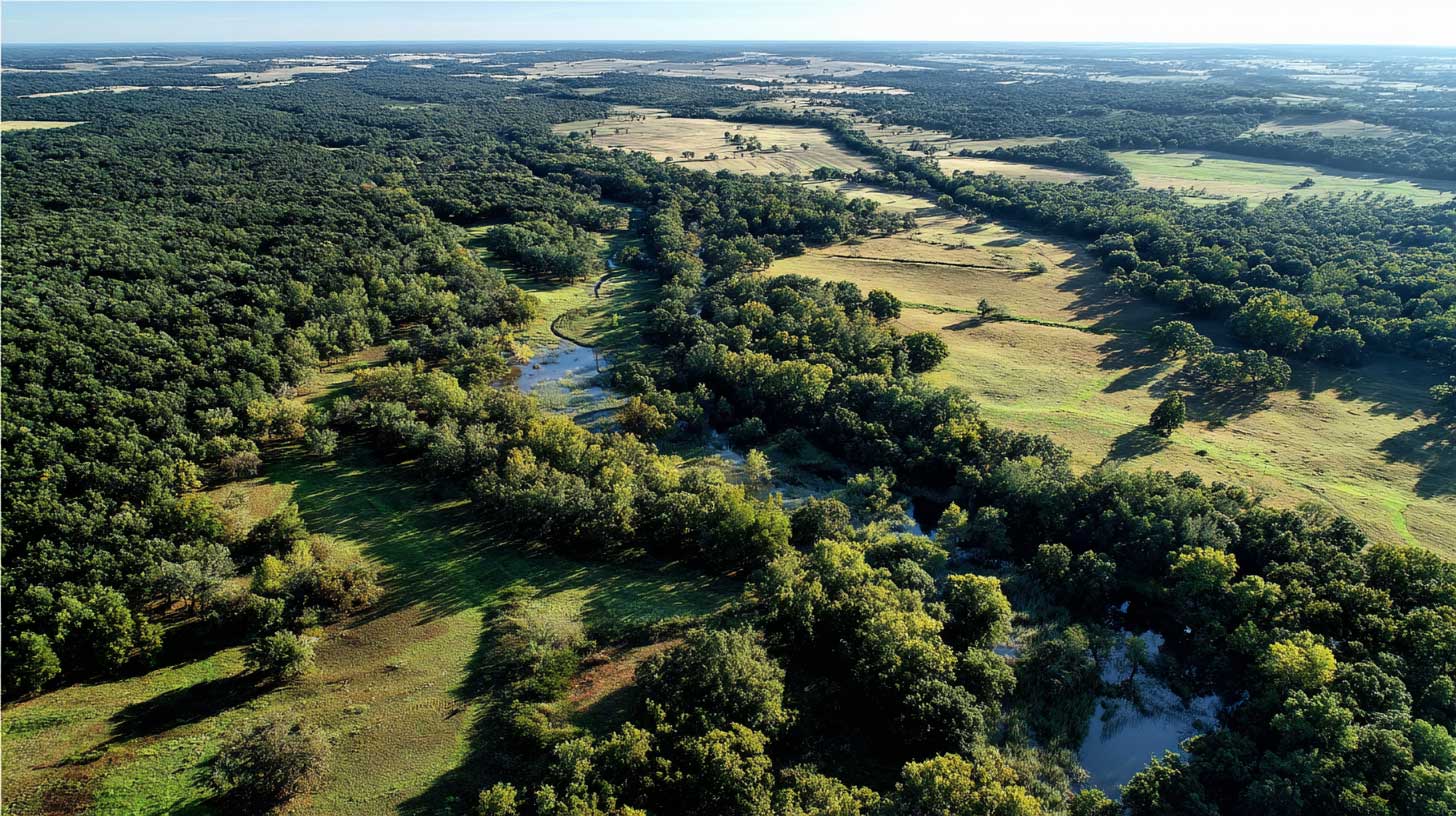
The county's geography is the differentiator. Hunt County sits at the eastern edge of the Dallas Prairie, where the terrain starts to shift from flat North Texas agricultural land into the more varied, wooded character of East Texas. You get creeks, timber, topographic relief, and wildlife habitat that simply doesn't exist in the flatter, more developed counties to the west.
For buyers who want a weekend retreat, a hunting property, or a rural homestead within driving distance of Dallas, Hunt County has been delivering the best value-to-proximity ratio in North Texas for several years. The driving forces — L3Harris Technologies in Greenville, East Texas A&M University in Commerce, and the I-30 logistics corridor — provide economic stability that rural counties without an employment anchor simply don't have.
The question is how long this window stays open. As Collin County builds out and Rockwall County prices escalate, buyers who historically stayed closer to Dallas are beginning to look east. That demand has started moving prices in Hunt County — but they are still well below where similar proximity-to-city land trades in other directions from Dallas.
Market Snapshot
Hunt County's land market reflects its position at the edge of the DFW market influence zone. Pricing is higher than deep rural East Texas but substantially lower than the suburban corridors to the west and north.
Price Ranges by Location and Use
Properties in and immediately around Greenville — particularly along I-30 and the US 69 corridor — are priced for their development and commercial potential. Tracts positioned for industrial, logistics, or residential development in the Greenville submarket range from $30,000–$60,000+ per acre depending on road frontage, utility access, and proximity to the L3Harris campus and I-30 interchanges.
Agricultural and pasture land making up the county's rural core ranges from $12,000–$22,000 per acre for straightforward grazing and hay production tracts. These are the traditional land buyer's entry point — meaningful acreage at a price that pencils without heroic appreciation assumptions.
Recreational and hunting tracts with significant natural features — creek frontage, mature timber, topographic interest, documented wildlife habitat — trade at a premium in the $20,000–$35,000+ per acre range. Well-structured hunting tracts with established food plots, blinds, and timber corridors are among the most sought-after properties in the county.
Lake Tawakoni-adjacent and waterfront tracts carry their own premium and are priced based on access, water frontage, and lot configuration rather than raw acreage value. These properties attract a distinct buyer demographic — lake life buyers, weekend retreat buyers, and retirees — separate from the agricultural and investment market.
Demand Indicators
The combined listing value of Hunt County land recently exceeded $613 million across roughly 14,862 acres — significant market depth for a county at this price point. Average listing size runs approximately 41 acres, a meaningful tract size that gives buyers flexibility without the capital commitment of large ranch purchases. The I-30 corridor continues to attract commercial interest as logistics and distribution operators seek lower land cost positions between Dallas and the East Texas markets.
Land Types Available
Agricultural and Pasture Land
The county's largest segment by acreage. Rolling blackland and sandy loam pasture supporting cattle grazing, hay production, and row crop operations (primarily cotton, wheat, and grain sorghum in the western portions of the county). Properties with improved pasture, cross-fencing, working pens, and water infrastructure command premiums over raw land. Native prairie and improved bermuda pasture characterize much of the central county.
Recreational and Hunting Tracts
Hunt County's position at the East Texas transition zone makes it one of the more productive wildlife habitats in the DFW region. Whitetail deer, wild turkey, dove, and waterfowl are common throughout the county. Properties with creek bottomland, mixed timber cover, and established food plots are actively sought by hunters and recreational buyers from the Metroplex who want weekend access without a four-hour drive.
Development and Investment Land (Greenville/I-30 Corridor)
Greenville's I-30 corridor is attracting logistics, distribution, and light industrial development. Tracts with highway frontage, rail access potential, and utility availability are valued for their commercial development potential. The L3Harris campus creates secondary demand from supplier and service businesses needing proximity to the facility.
Lake and Waterfront Properties (Lake Tawakoni)
Lake Tawakoni, on Hunt County's southwestern border, creates a recreational waterfront submarket. Lakefront and lake-view tracts appeal to buyers wanting water access, weekend retreat capability, and long-term recreational value. The lake draws significant regional recreational traffic and maintains strong buyer interest.
Rural Residential Homesites
10–40 acre tracts throughout the county appeal to buyers wanting rural character, livestock capability, and land as a lifestyle asset while remaining within commuting distance of Dallas and Greenville. Many carry existing ag exemptions and offer genuine value at Hunt County's price points compared to the suburban counties to the west.
Zoning & Land Use
Unincorporated Hunt County
Hunt County has no county-wide zoning authority outside city limits and ETJs, consistent with most Texas counties. Land in unincorporated areas can generally be used for residential, agricultural, or commercial purposes without county zoning approval. This flexibility is a significant advantage — buyers can build a barndominium, operate livestock, or run a small agricultural business without navigating a county permitting bureaucracy.
Hunt County does enforce septic regulations through the county environmental health department. On-site sewage facility (OSSF) permits must be obtained before any new septic system installation, and soil evaluations are required. Sandy loam soils in eastern Hunt County typically provide good drainage for septic systems; clay soils in the western portions of the county may require aerobic systems.
City Jurisdictions
Greenville is the dominant regulatory presence in Hunt County. The city has a comprehensive zoning ordinance, subdivision regulations, and an active planning department managing growth along the I-30 corridor. Greenville's ETJ extends into surrounding rural areas and carries subdivision authority. Buyers planning development near Greenville should verify current ETJ boundaries and applicable regulations before committing to a development plan.
Commerce, home to East Texas A&M University, has its own city ordinances and building regulations. The university creates demand for housing and commercial services but also shapes land use patterns in the immediate Commerce area.
Quinlan, Caddo Mills, and Wolfe City each have municipal ordinances governing development within their limits and ETJs, though these are generally less complex than the Greenville regulatory environment.
Subdivision Rules
In unincorporated Hunt County, tracts of 10 acres or larger with road frontage can generally be sold without county platting requirements. Dividing property into tracts under 10 acres triggers county subdivision review including road access, drainage, and utility provisions. Always verify ETJ status before assuming unincorporated county rules apply.
Water & Utilities
Water
Hunt County's water situation is more favorable than the western growth counties. The county has several surface water resources and a less acute supply constraint than counties like Wise County that are experiencing rapid population growth against limited infrastructure.
Lake Tawakoni on the southwestern county border is a major regional water supply reservoir, managed in part for municipal supply. The East Fork of the Trinity River runs through the county and feeds into the broader Trinity basin water system. The North Texas Municipal Water District serves portions of the county.
Rural areas outside incorporated water service areas rely on wells and rural water supply districts. Well water quality and yield are generally adequate across most of Hunt County, though buyers should conduct standard well testing during due diligence. Contact the applicable co-op or water district to verify connection availability for any specific rural property.
Electricity
Oncor Electric serves most of Hunt County. Farmers Electric Cooperative serves portions of the rural county. Line extensions for new rural construction can require significant capital — obtain extension cost estimates from the service provider early in the due diligence process.
Internet and Communications
Fiber broadband is available in Greenville and Commerce. Rural Hunt County has variable coverage. Nextlink, Starlink, and other fixed wireless providers serve rural gaps. AT&T cellular service covers most of the county, though coverage drops in some creek bottom and topographically sheltered areas. Broadband availability is increasingly a buyer requirement for rural homesites — verify connectivity specifically for any property under consideration.
Roads and Transportation
I-30 is Hunt County's primary arterial, connecting Greenville to Dallas (45 minutes) and to East Texas. US 69 runs north-south through Greenville and Commerce. SH 34 and SH 11 provide east-west connectivity. FM roads provide access to most rural areas throughout the county. There is no commuter rail — Hunt County is car-dependent, and I-30 traffic volumes at peak hours can extend travel time to Dallas to 60–75 minutes.
Infrastructure Watch
The I-30 corridor improvement projects are the key infrastructure investment to track. Any widening or interchange improvements between Greenville and the Rockwall/Kaufman County line will increase effective connectivity to Dallas and lift land values in Greenville's western commercial corridors.
Ag Exemptions & Property Taxes
Agricultural exemptions are widely available in Hunt County and represent one of the primary tax advantages for land buyers. The Hunt County Appraisal District (HCAD) is experienced with agricultural valuations across the county's diverse land types.
Qualifying Activities
Cattle grazing is the most common qualifying use throughout the county. Standard stocking guidelines for Hunt County run approximately 1 animal unit per 15–25 acres depending on pasture quality and rainfall, though the HCAD should be consulted for specific guidance. Hay production, row crop farming, goat and sheep operations, horse breeding with commercial intent, and wildlife management plans all qualify.
Timber and Forestry
In the eastern portions of Hunt County where post oak, blackjack oak, and other hardwoods are present, timber management can qualify for the agricultural use valuation or support a wildlife management plan. This is an underutilized strategy on properties with significant timber cover in the eastern county.
Wildlife Management Exemptions
Wildlife management valuation is popular in Hunt County, particularly on recreational tracts where traditional livestock operations are impractical. The property must have an existing ag exemption in place, typically for at least one year prior. Qualifying activities include habitat management, supplemental food and water, predator management, erosion control, and population census methods. Hunt County's wildlife habitat makes the documentation requirements relatively straightforward compared to counties with less diverse wildlife populations.
Beekeeping
Beekeeping has become an increasingly used qualification pathway for smaller tracts in Hunt County. The state requires a minimum number of hives scaled to tract size, documented active management, and evidence of honey production or pollination service activity. This is a practical option for buyers with tracts under 20 acres who want to maintain an ag exemption without traditional livestock operations.
Rollback Taxes
If a property with an active ag exemption is purchased and converted to non-agricultural use, rollback taxes apply for the prior five years. The rollback equals the difference between taxes paid under ag valuation and what taxes would have been at market value, plus 7% annual interest. In Hunt County's price range, rollback exposure on a 50-acre development tract typically runs $15,000–$40,000 — significant but manageable compared to the rollback exposure in higher-priced Denton or Collin County.
Growth & Development
Hunt County's growth story is driven by three distinct forces operating on different timelines, and understanding which one applies to a specific part of the county is essential for making smart buying decisions.
The I-30 Logistics Corridor
Greenville's I-30 position is attracting logistics, distribution, and light industrial development as operators seek land costs that work at scale, positioned between Dallas and East Texas markets. This story is playing out now — the L3Harris campus has anchored employment demand, and secondary commercial development is following. Greenville's western commercial corridors near I-30 are the most active investment area in the county.
The DFW Eastward Expansion
Rockwall County and Kaufman County, immediately west of Hunt County, have been experiencing DFW metro expansion for several years. As those counties build out and prices rise, the leading edge of DFW expansion is approaching Hunt County's western border. The Celeste and Caddo Mills areas are the early indicators. This is a slower-moving force than the I-30 logistics story, but buyers who watched the Collin County expansion pattern recognize the trajectory.
The East Texas A&M Effect
East Texas A&M University in Commerce (recently rebranded from Texas A&M–Commerce after the system consolidation) is a growing institution with increasing enrollment and research activity. University growth tends to create stable, counter-cyclical housing demand and supports a commercial and services ecosystem around Commerce. This is a slow but steady demand driver for the Commerce submarket specifically.
Northern Hunt County: The Long Play
Wolfe City and the northern portions of Hunt County remain genuinely rural with limited near-term development pressure. For buyers seeking maximum acreage at minimum price within 90 minutes of Dallas, northern Hunt County offers the best entry points in the North Texas region. The appreciation timeline here is longer, but the entry price makes the patience easier to maintain.
Schools & Community
School Districts
Hunt County is served by multiple ISDs with distinct characters:
Greenville ISD (approximately 5,800 students): The county's largest district, serving Greenville and surrounding rural areas. Growing alongside the city's commercial development. New school construction tracking population growth.
Commerce ISD: Serves Commerce and surrounding areas. Benefits from the East Texas A&M presence — the university creates a more academically engaged community context than similarly-sized rural Texas towns.
Quinlan ISD (Ford ISD area): Serves the Quinlan/Lake Tawakoni submarket. Growing with the recreational and residential development around the lake.
Wolfe City ISD: Small district with strong community identity serving the northern county's rural and ranch community.
Caddo Mills ISD: Growing district on Hunt County's western border, benefiting from the proximity to Rockwall and Collin County growth spillover.
Lone Oak ISD, Celeste ISD, and several other smaller districts serve the county's rural communities with the small-class-size, tight-community character typical of Texas rural education.
Healthcare
Hunt Regional Medical Center in Greenville serves as the county's primary hospital. For specialized care, Texas Health Resources facilities in Rockwall and the full range of Dallas hospital systems are 45–60 minutes away.
Character and Community
Hunt County retains a strong rural Texas identity built on agriculture, ranching, and small-town life. Greenville is evolving with its industrial and commercial growth — the downtown is experiencing modest reinvestment and the city is actively working to leverage its I-30 position for economic development. Commerce has the distinct character of a university town, with more cultural amenities and a younger demographic than most comparable-sized Texas towns. The county's northern communities — Wolfe City, Celeste, Lone Oak — maintain the traditional rural character that attracts buyers specifically seeking a departure from suburban North Texas.
Due Diligence Checklist
Before purchasing land in Hunt County, investigate these critical factors:
Water source and availability. For rural properties, verify the water source — city service, water district, or private well. Confirm capacity and any restrictions on new connections. For well-dependent properties, test water quality and yield. Contact the applicable water provider directly rather than relying on seller representations.
Soil type and septic feasibility. Hunt County's soils vary significantly between the clay-heavy blackland prairie in the west and the sandier loam soils in the east. Conduct a soil evaluation and verify septic system feasibility before closing on any property without existing sewer service. Eastern Hunt County's sandy soils are generally favorable; western soils may require aerobic systems at higher cost.
Floodplain status. Hunt County has significant creek and river systems — the East Fork Trinity, Caddo Creek, and other tributaries. Check current FEMA flood maps for any property near a water feature. Floodplain insurance costs can materially affect property economics, and floodplain encroachment limits buildable area.
Road access and easements. Verify deeded road access, not just physical access. Many rural Hunt County properties are accessed via county FM roads or private easements. Confirm legal right of access, maintenance responsibilities, and whether the road can accommodate construction traffic if you're building.
Ag exemption and rollback. Verify current ag exemption status with the HCAD. Calculate rollback tax exposure if you plan to develop or change use. On Hunt County tracts at current price points, rollback is a manageable but real cost that should be in your budget before closing.
Wildlife and timber value verification. If you're paying a premium for hunting or timber attributes, verify those attributes specifically — documented wildlife through trail camera data, timber stand assessment by a qualified forester, creek and water feature survey to confirm year-round or seasonal water presence.
Mineral rights. Verify whether mineral rights convey with the property. Hunt County has historical oil and gas activity in some areas. Severed mineral rights may mean surface use agreements, pipeline easements, or active well access rights that affect how you can use the property.
Survey. Get a current survey. Property lines in rural Hunt County may not match fence lines, and easements may not be obvious on physical inspection. A current boundary and easement survey is essential.
Frequently Asked Questions About Hunt County
How much does land cost in Hunt County Texas?
What is Hunt County known for?
Is Hunt County a good land investment?
Is Hunt County good for hunting land?
How far is Hunt County from Dallas?
What are the large employers in Hunt County?
Can I build a barndominium in Hunt County?
What about water access for irrigation or livestock?
Ready to Buy Land in Hunt County?
Our team has deep expertise in Hunt County properties. Let us help you find your perfect piece of land.
Contact Our Team